The Broadcast Engineer Unicorn

#Offering Help: #Mentoring, #Writing, & #Engineering Services

I’ve been fortunate throughout my 33 year career to have found many mentors. I now happily find myself still working, but also mentoring the next generations of broadcast employees. Not only to have had such a diverse career So Far – it’s certainly far from over, but a female engineer in the world of broadcasting I have been termed a Unicorn. Who me? Yup!

Indeed, for many many years I have found myself to be the only female in the room. The only adult in the room, but that’s another story. I’d be promoted into a full room of men and me. If there was another women, she was an assistant or secretary, so I’d do my best to be inclusive and share insight. Paying back the kindness that was so graciously bestowed upon me along the way.

Although, I have to say, I was underestimated along the way as well. I didn’t spout or boast my knowledge, pat myself on the back for a job well done, I just kept my mouth shut and did my job, and did everything I could think of to “move the needle forward” for women in broadcasting.

Unfortunately, back then the loudest person in the room was thought to be “right” or the most knowledgeable, I certainly wasn’t loud, so I took the brunt of a lot of wrongs. Should I have spoken up? Looking back, absolutely yes, I just didn’t have those tools in my toolkit – YET.

Finally one day, I started a new job in the control room. I had not only one woman boss, I had two! I felt lucky. I was in certain respects, in other respects – uh, not so much.

I won’t distinguish which was which, but one superior was never satisfied. If I took care of every single aspect of my job, went beyond what was expected, took initiative to do more, it still wasn’t enough. More was thrown at me (sometimes literally) and I would scramble to “figure it out”. I could ask the other superior clarifying questions, but mostly I was on my own, they were both busy, and that’s why I was there right? Sometimes yes, sometimes no.

Finally about 3 months in, the superior who was never satisfied went on a 2 week vacation. I was elated, and for good reason. The other “boss”, would check in with me, and on my 2nd day with just her in-charge, she physically came into the control room. I showed her all I did, what I was watching for, what I still needed to finish, and of course asked if I could help her with anything. A simple “Nope, I’ll be in my office, if you need anything, call. You’re smart, I trust you, and I know you won’t wait until you get into trouble to call me”. Then she left. Wow! What a feeling of empowerment.

To this day I do not know that that boss knows what she gave me. Autonomy for one thing, but also confidence. She gave me an example of how I wanted to be when I was in a position like that, respectful, inclusive, giving, everything I needed summed up in a short sentence. Not only did I learn what I wanted to be like, I learned something even more important, what I didn’t want to be like. I didn’t want to create/rule by fear every time I walked into a room, I didn’t want to make anyone feel less than, no matter who they were, I didn’t want to make anyone feel like they were only as good as their last mistake. And so, I’ve taken that goal and hopefully not only successfully achieved it, but surpassed it.

I knew what I wanted, so then I sought out through positive leaders/achievers in and outside of the company. Learned from their vast historical knowledge and applied it to new ways of developing standards. All the men and women of my past have made me who I am today.

Have I made mistakes? Absolutely. Really big ones? That’s an even bigger Absolutely. Have I learned and grown from them? Absolutely. Do I regret some? Absolutely. I don’t regret learning from my mistakes, I regret how I handled my failures sometimes. We all fail sometimes, or a lot of the time, but it’s how we get back up, how we recover that matters. It’s not how you start, it’s how you finish.

I cannot change the past though, I can only move forward with integrity and perseverance in the future. I can pass on my knowledge to usher in the new generations. And, I do.

In 2019 I took a seasonal broadcast streaming engineer position at MLB Advanced Media. I was fortunate to work with a newly assembled group of engineers. All men and me (a Re-occurring theme throughout my career). Not only was I the only woman, I was also the oldest person in the room by far. The youngest wasn’t even born when I graduated college, he wasn’t even of drinking age yet. But he was/is brilliant. The takeaway is to remain open, accepting, giving, and teachable. And, check your ego at the door.

It was a new system that we all rolled out in only 3 months, so we All were learning something literally brand new together. It was extraordinary. I had as much to learn, and unlearn as they did, but we did it all together. To this day it was hands down one of the best teams I was ever a part of. We all worked together in this small closet of a room, and we successfully streamed out 32 minor league team’s games for the season, ending in an all time high of adding in some major league games too. We all helped each other through processes and SOPs, it was amazing.

The season ended, some found other full time jobs, the rest of us stayed on part-time to work on Major League ballpark infrastructure upgrades in the off-season. Another great experience. But we did it together. I’ve gone back as a part-time employee season after season with great anticipation and openness to learning all the new tech forward innovation each year. I am truly grateful to have found MLB, and many others along my Broadcasting journey. I was asked once, “What will you do when or if they hire another girl/ woman for this office?”, my response was simple, “I’d throw a parade first, then make sure you all treated her with the same respect you’ve shown me (which was a lot, and it never waivered), or you’ll have to answer to me!” That was said with a somewhat joking lilt, but it was true then, and true now. That was verbatim comment recollection. Very smart, accomplished women were hired, and the respect was given, I was proud of this group of fine men and now women.

It’s not over yet – not by a long shot!

If you’d like to chat please feel free to contact me. I can learn just as much from you as you can hopefully from me.


The Power of the “Learn More” call to action

#OfferingHelp: Career Coaching, Volunteer Work, Business Email Writing

As website visitors, we are constantly bombarded with calls to action (CTAs). Some of these CTAs are more effective than others, but one that always grabs our attention is the “learn more” CTA.

Why is the “learn more” CTA so effective? There are a few reasons. First, it implies that there is more information to be had on the topic at hand. This can be appealing to curious visitors who want to know more about what they’re reading about.

Second, the “learn more” CTA doesn’t ask for much from the visitor. All it asks is that you click a button or link to learn more. It doesn’t require any commitment on the part of the visitor, which can be important when trying to convert someone into a customer or client.

If you want your CTAs to be effective, make sure you include a “learn more” option!

High impact emails can help businesses in a number of ways. They can improve communication, increase efficiency, and build relationships with customers and clients.

“All roads in the copywriting world lead back to emails…. “

This quote is from famous copywriter and marketer, Neil Patel. And it’s true! Email marketing is one of the most important tools in a copywriter’s toolkit.

Email marketing allows you to stay in touch with your audience, build relationships, and sell your products or services. It’s a powerful tool that can help you achieve your business goals.

So if you’re feeling stuck or lost in the world of copywriting, remember this quote and keep emailing!

For every $1 you spends on email marketing — you’ll gain $38 back.

The demand has been created from the standpoint that the most effective emails make real connections with real people — by offering to take them to information they’ve asked to see that’s relevant to their needs, wants, and desires.

Spam, clickbait, and other unethical email practices will never work to create personal connections or offer information that is relevant to customers.

Emails that are effective establish a link between what the company has to offer and what the customer needs in order to improve their life. They bridge the gap between businesses and consumers in a way that is mutually beneficial.

If you need help with writing, I would be more than happy to assist you. I offer high-quality writing services and can work with you to create the perfect piece of writing for your needs. Contact me if you’re interested in learning more or if you have any questions. You can contact me @ Nicole.Gabriel@gmail.com, or on LinkedIn.

I look forward to hearing from you!

#people #connect #bettertogether #buildyourbusiness

Success at Job Hunting in the Universe’s Vacuum

If you want to be successful in job hunting, you need to be persistent and never give up. You need to believe in yourself and your ability to find the right job for you. The universe is full of opportunities, and it’s up to you to find them.

I started a great new position this week. After years of seasonal, and short contract work at various places, I wanted to find something full-time, and permanent. Permanent is a relative term to me. One can be “let-go” at any time these days, because there was a restructuring, not because one wasn’t doing well, for cause, or just lay-offs. It can be disheartening.

When I was offered my current job, I literally had gotten another offer the very same day, and a third offer the next day. I asked each possible new employer further clarifying questions so I could make an informed decision. That doesn’t give me any guarantees, but gives me the best chance at what I want and need. Note: I also only applied to jobs I really wanted, but was still looking because nothing was “final” until I, and the company have finished the on-boarding process. But, more on that another day.

FINDING THE OPPORTUNITY

Fear not, there are many opportunities out there, one just has to find them. Make looking for a job, a full time job in itself. Let me break it down a bit with some specifics. Set-up job parameters with automated Daily alerts on multiple sites, visit specific company sites daily (there are jobs there that are not posted publicly), filter for job keywords, position, desired location, (or on-site,remote/hybrid), and then of course latest or newest listings. This cut down on how “far” back anyone will have to cull through a seemingly endless list of jobs (most of which that wouldn’t fit one’s skill-set, or ones that aren’t of interest, or titled oddly). I only applied to jobs I wanted, and that I was at least 80%+ qualified for. My resume was updated nearly weekly to tweak it, and so was my cover letter.

BOTS

I’m sure job-seekers already know about HR bots: ATS system: Applicant Tracking System. It’s designed to automatically find keywords from the job description and find those skills in your resume automatically. If your resume doesn’t match up to a certain percent, then it automatically gets rejected, and the hiring manager, or HR person never gets to see your resume at all. So weave the keywords from the job description into your resume (assuming you truly have those skills), and your resume will actually get a human’s eyeballs to look at it.

Otherwise you’ll more than like get the dreaded automated response of, “while we are so excited that you’ve spent time applying for this position, and you’re highly skilled, we are not moving forward with your candidacy, and moving forward with other candidates that are more closely aligned with this position.” Even worse, you may have now been put into their system in an automatic reject for X amount of time. It’s true, so always try to present yourself in the best light, your effort upfront has big pay-off.

Now, keep in mind, every company must legally post a position even if they already know the candidate they Will be hiring. I’ve gone to job listings that were only a few hours old, saw there were no other applicants, but also was removed or “no longer available” almost as soon as it was posted. “Whatttt!!!??” The company legally did what they had to do, they posted the job, then removed it as soon as legally possible. I found this annoying at first, then took a different purview of the action, “at least I didn’t waste my time going through the entire application process”. It all depends on how you look at it. I chose the latter – be positive.

CONNECTION IS KEY

If you have a connection at a company you’re applying to, reach out to them. This is not just to ask them to recommend you, it’s also exploratory to find out more about the company, and if you want to work there too. It’s equally important for YOU to interview the interviewer about the company, culture, company and job challenges, who had the position prior to this, where did they move up or onto, and why. There are many other questions, but that’s a good starting point.

Next, there is the “quick apply” tactic. Job sites that offer a seemingly “one-click” application process, followed usually by a couple of generic questions like: Are you a US citizen?, Will you now or ever need sponsorship?, and are you at least 18 years old? I would advise if you decide to apply this way that you should also write a cover letter if the app provides the option. If not, note who the hiring manager or job poster is, and contact them through email if provided, or LinkedIn (In-mail).

DUE DILIGENCE

Don’t underestimate the cover letter. Many Recruiters and Hiring Managers automatically reject resumes from highly qualified applicants simply because there was no cover letter. Why? It shows interest, and a level of effort. Even if you don’t have the name of the job poster, or hiring manager, simply start with Dear Hiring Manager, then in the body of the cover letter say why you’d be great in the position, something that’s NOT in your resume and be positive.

Finally end with something like, “I look forward to hearing from you”. Then your signature. Boom! You’ve written a few short sentences and “Submit”. You’ve just upped your chances of being contacted by a Recruiter (whether in-house or not) by approximately 80%.

FOLLOW THROUGH

Lastly, if you haven’t heard anything for over a week, follow-up with a “checking in” email. Don’t ask for a response, the hiring manager and recruiter are very busy people. Just let them know you’re still interested in the position (you didn’t just one-click apply). A little effort goes a long way. If you’re willing to put the effort in before you have the job, you’re a good candidate to actually DO the job.

If you’d like more tips please leave questions in the comment section, or email me directly (it’s in the contact area of this site).

Good luck in your search. I look forward to hearing feedback from you!

The Green Room in the Cloud

Beginning a new position at a new company, working with a new team is exciting, maybe a little scary, but full of potential. Broadcast production is changing at a breakneck pace with cloud streaming, SMPTE2110, bandwidth constraints, NDI, RTMP, RTSP, SRT, HLS streams, SFPs, CDNs, and a mountain of other technology devices, and Software as a Service (SaaS) growing exponentially everyday.

Doing more with less has always been the trend. Now that is the rule rather than the exception. Not only do we need to do more with less, we need to automate systems, and have automated notification systems to let us know what may be going wrong.

This does not absolve us from manually checking -in, usually remotely though. Bots are now not a luxury, they are a necessity, but they still do not override the humans who run them. Remember, you come first, people come first. We need to take the sailing saying “one hand for yourself, one hand for the boat (to hold on). This is the epitome of taking care of yourself and whatever your “boat” is, and being safe.

You can’t give away what you don’t have. If you’re not ok, you cannot help or be of service to someone else. Remember self care? Give yourself a minute or five for meditation, a walk, a phone break to connect to another human (especially if you’re working completely remotely).

Speaking to that end, make sure you stay connected with your boss, and work team. If YOU are the sole team member, reach out to others outside of your group to interact with them, take a class, join a business volunteer group – stay connected, and communicate. Communication is key.

Luckily in production, even technical fully remote production, I HAVE to communicate with colleagues daily. It is very satisfying to me when I’m solving problems – fixing issues is how I work. Find out what excites you, and go after it. It may not happen overnight, but it is possible. The journey is not always easy. That maybe just for me though. I do feel that if I’ve worked for something and the “result” isn’t what I wanted, maybe I wasn’t specific enough as to what my intention was. So, I drill down to more details of what I want (which is always to be challenged to fix something).

This applies not only to work. I love fixing things in the house. Whether it’s spackling and painting a hole or spot on wall, changing out the broken igniter on the heater, reinstalling the screen on the front door, or cutting the hedges in the yard. This is also the basis on how I approach sports.

Take golf for instance. Recently a good friend bought a brand new set of highly technically advanced Callaway clubs. Now, there are many choices out there, and her “old set” of Callaway Rogues are in perfect condition. I’m a newer golfer, but have found a great love for the game and its process (even on a bad day), but I bought the “old” set of Rogues for a deal. I took my golf lesson with them, and then played a round with them the next day. Today I’ll goto the driving range, chip out of sand bunker, and putting green to continue my process.

“New” used Callaway clubs, my old bag, but it all works

The point is, we never know when or where an opportunity will pop up. I in turn gave away my old set to someone just starting out like I had last year. Yes, I bought the set, but watching someone have a true love and interest in growing themselves made me want to pay it forward and give to them in turn. I do a lot of volunteering as well, there are many ways to give back. Your time and attention to someone in need is invaluable!

Pay it forward in all aspects of your life, whether in-business, health, friendship, volunteering, being a good neighbor. We are here for more than ourselves. It’s a great-big world out there, be apart of it, you’ll be better all around for it. I call that being IN the green room.

My new job is completely remote, it’s a great team, and we learn everyday. We “live” our work-lives virtually in the cloud, but we are together in the production “green room”.

Shot in the Dark… Monday Night Football, Dallas Cowbows @ Philadelphia Eagles, my first MNF game

After a full summer of PGA Tour Golf, Horse Racing, Auto Racing, and Bowling, so many events I don’t think I could list all of them. It was time to head back to the University for my second year. It was also the start of Football season, a whole new sport that I hadn’t worked on – YET. It was the first in-season game the Dallas Cowboys vs. Philadelphia Eagles @ Veterans Stadium.

I finished my last class on Friday at 2pm, I had already packed my car, and was Ready To Go. I now had a Chevy Cavalier that my brother fixed up for me to drive. So, off I went from Northern NJ, to Pennsylvania just a few hours to drive. My first football game, the cabling was basically set, but the skill set for Football, is vastly different than for Golf, Horse & Auto Racing. But, what I did know, and always brought with me was the willingness to learn and grow from each experience and to build upon each one. The Field Production and Technical Managers were more than willing to show anyone with the curiosity to learn what they knew too. It was an amazing time in life. The possibilities were endless, as long as I was open to them. That remains true today too.

“Our intention creates our reality.”
– Wayne Dyer

I had made a Co-Op for my major out of this freelance job, and I was also getting paid to do it (I was “promoted”, and now made $75/day instead of just $50/day), Incredible opportunity. To ensure I didn’t miss many classes I was able to make all of my classes start on Tuesday and run to Friday.

I got to Veteran’s stadium a few hours later, parked in the designated area, and checked in with my PM. They were working with the blimp guy at the time, so I listened and took notes just to understand what he needed and when. Old school style still, pen and small notepad. Ok, we printed out the crew schedule, I posted it, made sure everyone knew their call times, made sure everyone had turned in their paperwork to onboard, and we were set to go. It was late, so off to a nearby hotel we went. Simple digs, but comfortable, but also no other young women were working the event so I was alone. I didn’t go to the gym that night, I went to sleep!

The next 2 days, I was raring to go, I got to the site early and opened up the production trucks and got everything ready for the PMs and TMs. Because, if I was on-time, I was already late! We spent the day planning and setting up telecom, and other technical aspects of the broadcast. We gave updates to the SVPs that were going to come to the game, ensured that we had badges for all, and knew exactly where they would be seated. I know that doesn’t sound exciting, but I thought it was because I wanted to not just a good job, I wanted to do a great job. I enlarged travel directions to fax to all the execs, and received confirmation that they had gotten them. I think we’re set.

Monday, here it is – game day. Later than expected, I was asked to go pick up some other supplies that the blimp guy had asked for at the last minute. It was getting dark out, but – No Problem. They usually sent us out in pairs, but everyone else was busy, so I was told to take one of the rental cars, pick up the gear at a local store, and come right back. Again, no problem. I called the store, they had the items ready, so off I went. But, I made a wrong turn, I had no idea where I was, and it wasn’t good.

There were abandoned cars, and heaps of garbage everywhere, I kept driving thinking I’d get to a street on my printed map. I didn’t. Suddenly there were 2 cars that blew passed me on each side, I slowed down to nearly a stop.

“Whew”, I stopped at the top of the block, that was crazy! I’m not done… At the end of the block there were a few cars facing each other and suddenly the men jumped out of the cars, pulled out guns, and started to shoot at each other! I saw the whole thing. I saw people get shot! It was like a movie, almost not real, except it was, and again I saw the whole thing! I didn’t know what to do. I put the rental car in reverse to back up, and went down a side street shaking, terrified, discombobulated, numb, those were real people, that was real…..

Finally, I saw a police car and drove straight to it. I rambled nonsensically on and on and on to the officers about what I saw, not even sure what it was that went on, and even though I wasn’t sure of the name of the street it all happened on.

I knew nothing. Ok, I knew the color of the cars and makes and models since I used to be a “helper” to my brother when he fixed cars, but other than that, I couldn’t give a good description of the people involved, it all happened very quickly. They took my statement, and where I was staying, I even gave them the pay-phone for my dorm floor if they needed to reach me after I went back to NJ.

Shakily, I asked the officers how to get to the store I was looking for, it wasn’t far, I picked up the supplies and returned to the production area dazed, worn-out, and still shaking a bit, but I DID feel safe with the crew. I never went out alone again btw. Focusing on work, and getting everything ready helped after a minor break, everything was done.

The PM had me sit with him for the remainder of the game, someone else would take the execs to their seats. We broke down in 3 hours what it took 3 days to build up, which always amazed me, and I decided to goto the hotel, check out right away and go back to the University. I didn’t want to be alone in the hotel room, I wanted to be back at school as soon as possible. Not my greatest idea, I was tired, still stunned, and then I had to walk to the dorm from the far dark parking lot alone at 6am. I got back safe and sound, my roommate was asleep, I quietly took a shower and tried to sleep.

Now what? I didn’t know, thoughts were racing through my mind, they undermined my confidence, it was shot (no pun intended) for the moment. But this too shall pass, won’t it? “Should I continue this life?”, “this was a fluke”, “what just happened”, “should I tell me parents?”, “should I tell anyone?” The sound of the live gunfire still perfectly resonated in my mind. Those men are probably dead – OMG!

I never did hear from the Philadelphia police, I DID tell my parents, I DID go on to do the entire season of MNF. I left school every Friday (even the following Friday after the shooting) after my 2pm class ended, whether I drove or hopped on a plane, I’d get to the site, set-up, break-down, go back to the University and made most of my classes. I continued to study on the plane – no matter what.

Lessons Learned: Don’t let fear stop you ever. Fear doesn’t stop death, it stops life. Face Everything And Recover, it does get better. The memory is still here as I am writing this – it’s palpable even now, but I know I have the tools to handle it. Friends, family, therapists, there’s no shame in admitting you need it. It is what it is. Not to be cliché, but I cannot change the past, nor was anything my fault, I was just in the wrong place at the wrong time. Keep moving forward No Matter What.

That was the first time I ever saw anyone get shot, but it wasn’t the last.

The Nabisco Dinah Shore Golf Tournament

The 5th Green at Mission Hills Country Club, Rancho Mirage, CA

“I have no special talent. I am only passionately curious.
– Albert Einstein

If you read my post on “How it all started: My First Unpaid Production Runner Experience in Sports Broadcasting”, this is my first paid job for sports broadcasting. I was directly asked “Do you want to do golf”? Of course I did! But, I had no real idea what that really meant yet, but there was travel and adventure ahead! I kept in touch with the Senior Production Manager at the alphabet company via a pay phone for the entire floor in my dorm, not easy when my peers would tie it up for hours talking to family, friends, boyfriends and girlfriends. I didn’t have email yet, no in-room phone, much less a cell phone (brick) yet. I called between classes during business hours to check in about every week. Most of the time I was leaving voicemails because I didn’t realize at that time that the SPM would be traveling to remote sites, and not at his desk most of the time. So I just kept checking in. Hmmmm, maybe I’ve been forgotten already. I didn’t even hear back from the more junior PM.


Then finally one afternoon, someone picked up the phone. The secretary to the Sports team, she put me through to the junior PM (who is now the VP of Operations at a Giant Baseball network). We spoke for a few minutes setting up a plan of action, and what was expected of me, and how I could plan to “make this work”. I was booked to fly to California to the Nabisco Dinah Shore Golf Tournament during my spring break. I would miss some classes because of it, so I approached all my professors and let them know I wouldn’t be in class the days after spring break and why. All where just fine with it, except for my chemistry teacher since one was a lab day. I made it up though. So, off I went, excited, nervous, what do I pack? OK, a White collared shirt and khakis, no jeans. Pens, paper, and an old school personal handwritten phone book with my family, friend’s, and now business contacts information in it.

My first time on an airplane. A friend drove me to the airport, Trembling with enthusiasm I checked in, checked my bag, I was going to be there for 12 days after all not really knowing most of the 60 person crew. Hours later I landed in California, right on time. As instructed, I picked up a rental car that was set aside for me, and off I went to check into the hotel. Wow! What a beautiful place sunny, warm, expansive, then I looked up at the nearby mountains and there was snow, yes snow on their caps, it was unreal. I got to stay in a five star hotel in Indian Wells, CA! I shared the suite with 4 other young women production assistants. There were 2 beds, a roll-away bed, and a sleeper sofa. Hmmm, that’s 4, since the hotel only allowed 1 roll-away bed, and I was the newest member of this crew, so I just put the cushions from the sleeper sofa on the floor and slept there. I did just that every night, and even when I was a more senior member of the crew in the coming years, I still slept on the sofa cushions on the floor. All was set, we all unpacked and went to the work site.

What a beautiful worksite it was in Rancho Mirage, CA. I GET to “work” here for almost 2 weeks, this is a dream I thought. And, it was.

We took care of the golf carts, helped the tech managers track equipment and cabling, learned more about wiring from some of the Tech Managers, and then the tech records folks came in to onboard the crew and track hours. My first paid Sports Broadcasting job, I was paid $50/day and worked about 16 hours a day, no overtime but I didn’t care. It wasn’t hard work, I started to learn the union rules, and was told to make sure I knew about meal breaks, what was required for them, and to ensure every piece of the contract was fulfilled. The SPM left that to me, and luckily the junior PM was the same one from the NYC marathon so I knew how they operated, at least a little bit by then. I poured over the rules, showed up early, stayed late to ensure all the rules were followed including driving back to 2 other hotels to make sure the crew schedules were posted in-time for the next day.

Socializing. I didn’t go out with the crew of other production assistants after work, they were all a couple years older than me, they went to the bar, I went to the luxurious hotel gym. They did that every night, and so did I. I wasn’t old enough to drink legally, and I didn’t wish to either, but that didn’t win me any friends with some of the staff.

A few days into prepping the event, one of the young female production assistants accused me of stealing her favorite T-Shirts. She went to the SPM and JPM with her accusation. She made sure I was in the production truck when the accusation was announced, I had no idea what she was talking about. But, by this time, I had already proven myself to both managers, and both began to laugh at the statements being made against me. They both said “You don’t know who you’re talking about, she wouldn’t even take a pencil off-site”. Absolutely true.

Later that evening after we all returned to the hotel. The young woman who accused me of stealing from her found her favorite T-Shirt in a drawer she forgot she used. She never actually apologized, but we were on ok terms again. I let the whole thing go knowing I did nothing wrong, and also knowing holding onto that kind of grudge would never create a fluid working environment. I never even worried about the accusation, because I knew I didn’t do anything wrong. So, instead of insisting on an apology, and knowing I was “in the right”, I decided to be happy instead. I didn’t need to be right, I knew I was, the bosses knew I was, and all was well in my first dream Golf-tastic job.

Yes, $50/day wasn’t much but, they paid my airfare, car rental, we had gas cards, they fed us meals, we were trusted with petty cash, turning in receipts and change, charging the golf carts, making hundreds of copies (sorry trees), and then making sure all the union rules were followed so work would start and continue on-time throughout the day.

We had one day off during the event, so we went to the pool, ate free apples from the spa, and went to the gym. I was finally really hanging out with all the other production assistants, yes All of them including my accuser, and we had a great, fun, and relaxing day together. It was back to work as usual the next day, but no matter what we had that day together. Thank you Universe!

When it was tournament time we faxed directions to the Execs coming, greeted them at the airport, and made sure everything they needed was in-place when they arrived, and it was. We got to the final day and wrapped, bringing in thousands of yards of tri-ax cable, packed up trailers, then we all departed the next day. “Until the next one, see you soon” was heard over and over again. It was an amazing experience with an amazing group of people. I had already learned so much, and I was thirsty for more. More was to come in many other golf and a multitude of other sporting events which I will share in future posts.

I returned to the University, studying all they way back on the plane so I could make up that chemistry lab, which I got a 98 on, so all was well in the world. I told my broadcasting professors about the experience, and low and behold I made a co-op out of it. By graduation I had gotten paid to work in the industry I wanted to work in and gained 16 credits as well for the experience and writing it all up in a few papers. A win-win!

So, anyone looking to break into broadcasting, I say go for it! Be persistent but not stalker, don’t give up on your dream. Be curious, honest, humble, and willing to take on tasks outside of your “job description”. To this day, I will still be the first one in, last one out, sweep the floor, and take out the garbage whenever I need to, I will never be so “big” that something is below me.

What’s next Football…

Nano-Metals

 Nano-Metals:  One green theory is on an upswing in Green Technologies –  it’s not new though, it’s been around for centuries.
________________________
Quick Review of nano-metals
Nano-metal (also called metal nanoparticles) is very attractive and that is because of their size and shape dependent properties. The optical properties (linear and nonlinear) depend on that and they on dominated by something called the collective oscillation of conduction electrons. There are so many ways that you can prepare metal nanoparticles but the most used methods are based on wet chemistry. You can find nanometal being used in medical applications to the weaponry the military use. Nanometals also have a thing called Surface Plasmon Resonance (SPR) this is what cause the change in colors that we see. For example in the 4th century when the Lycurgus cup was created. The cup changes red when the light is shone inside of the cup and green when reflective light is shone on the outside of it. There are so many methods that you can prepare nanometals and the most popular way is by reducing HAuCI4 (Hydrogen, Gold, Carbon, and Iodine) in a sodium citrate solution that is boiling and then the formation of gold nanoparticles are revealed by a deep red color that look like wine in about 10 min.
Types of nanometal synthesis
The most common types of nano-metal synthesis deal with ‘wet’ methods in which metal nanoparticles are produced in a colloid with an organic material of some sort.
Gold nanoparticles can be produced by either:
1) Reduction of HAuCl4 in a solution of sodium citrate, then boiling it, causing gold nanoparticles to form in a wine-red solution.
2) Mixing HAuCl4 in water, which produces a solution that is subsequently transferred into toluene using tetraoctylammonium bromide (TOAB), a phase transfer catalyst. Phase transfer catalysts help reactants dissolve in organic (carbon-containing) material where the reactant otherwise couldn’t w/o the PTC. Afterwards, the solution is stirred with sodium borohydride, in the presence of certain alkanes, which bind to the gold in the solution, allowing for the formation of gold nanoparticles.
Synthesis of other metal nanoparticles can possibly be achieved by reducing metal salts in organic solvents such as ethanol, or by variations of the above methods which synthesize gold nanoparticles.

Green Dry Cleaning

Almost everyone owns clothes with that “dry-clean only” label. But traditional dry cleaning requires toxic chemicals that can be environmentally harmful, and we often have to choose between a clean suit and a clean environment. Luckily, there are green alternatives that can reduce the impact of dry cleaning chemicals and other materials. All you need to help mother nature, and yourself, is a few hints and tips.

Here’s how to dry clean your clothes without damaging the environment:

Chemicals.
Traditional dry cleaning machines use a chemical called perchlorethlyene, which contains chlorine and may be harmful to both humans and the environment. Modern machines use less of this chemical, but it is still present.

Alternatives.
“Green” dry cleaners use a newer process that makes use of non-toxic solvents. According to Davis, having your clothes cleaned at these eco-friendly cleaners costs no more than having it done the old toxic way.

Ask questions.
The best way to find and environmentally safe dry-cleaner, says Davis, is to call your local dry cleaning association.

Air out clothes.
If you must use a traditional dry cleaner, make sure to lessen your chances of breathing toxic fumes. When you get home, remove the clothes from the plastic bags and let them air out.

Make requests.
You can also help out the environment by asking your dry cleaner to put more than one garment in a bag, thus reducing your consumption of plastic. Ask if there is a recycling program for the bags, and recycle whenever you can.

Think green.
Don’t be afraid to talk to your dry cleaner about eco-friendly options, and to take your business elsewhere if you aren’t satisfied. Small actions and decisions add up, and by striving to protect the environment with all our daily choices, we can keep the world healthy for ourselves and for future generations.

Military Motion Powered Electronics Goes Commercial

pic2

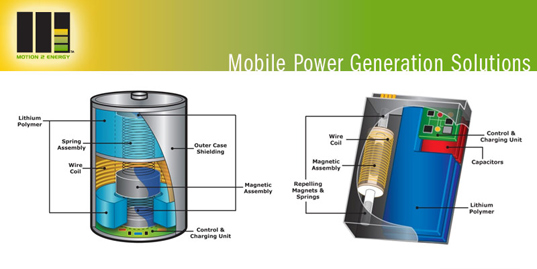
M2E Power’s push to develop motion-powered electronics for the military. Now M2E is emphasizing the commercial applications for their technology, with a specific goal: revolutionizing cell phone batteries. M2E will announce the development of an external charger later this month that will generate between 300 and 700 percent more energy than current kinetic energy technologies, and may eventually replace cell phone batteries altogether.
M2E’s technology is founded on the Faraday principle, wherein energy is produced from the motion of a magnet passing through a coil. M2E says they have designed a system that will generate between 300 percent and 700 percent more power than kinetic energy technologies currently available.
Their design consists of a tiny coil/magnet generator combined with traditional battery storage that will capture even low frequency kinetic energy, so that most daily human motion will be converted into electricity sufficient to power electronic devices like cell phones, PDAs or MP3 players.
M2E is looking to incorporate their technology into a variety of fields – their web site teases that “The impending impact of MEMS (MicroElectroMechanical Systems) will be both exciting and far ranging” and hints at applications for wind power, automotive power and small generators. M2E also hopes to eventually create motion-powered batteries that rival consumer-sized ones – D, AA and even AAA cells.

Nano Crystals

Nanocrystal solar cells or quantum dot solar cells, are solar cells based on a silicon substrate with a coating of nanocrystals.

While previous methods of quantum dot creation relied on expensive molecular beam epitaxy processes, fabrication using colloidal synthesis allows for a more cost-effective manufacture. A thin film of nanocrystals is obtained by a process known as “spin-coating”. This involves placing an amount of the quantum dot solution onto a flat substrate, which is then rotated very quickly. The solution spreads out uniformly, and the substrate is spun until the required thickness is achieved.
Quantum dot based photovoltaic cells based around dye-sensitised colloidal TiO2 films were investigated in 1991 [1] and were found to exhibit promising efficiency of converting incident light energy to electrical energy, and were found to be incredibly encouraging due to the low cost of materials in the search for more commercially viable/affordable renewable energy sources. A single-nanocrystal (channel) architecture in which an array of single particles between the electrodes, each separated by ~1 exciton diffusion length, was proposed to improve the device efficiency (figure below) [2]and research on this type of solar cell is being conducted by groups at Stanford, Berkeley and the University of Tokyo.
Although research is still in its infancy and is ongoing, in the future quantum dot based photovoltaics may offer advantages such as mechanical flexibility (quantum dot-polymer composite photovoltaics [3]) as well as low cost, clean power generation [4] and an efficiency of 65%.[5].
Recent research in experimenting with lead selenide (PbSe) semiconductor, as well as with cadmium telluride (CdTe), which has already been well established in the production of “classic” solar cells. Other materials are being researched as well. These materials are unlikely to have an impact in generating clean energy on a widespread basis, however, due to the toxicity of lead and cadmium.
Polymer solar cell
Polymer solar cells are a type of organic solar cell: they produce electricity from sunlight. A relatively novel technology, they are being researched by universities, national laboratories and several companies around the world.
Currently, many solar cells in the world are made from a refined, highly purified silicon crystal, similar to those used in the manufacture of integrated circuits and computer chips. The high cost of these silicon solar cells and their complex production process has generated interest in developing alternative photovoltaic technologies.
Compared to silicon-based devices, polymer solar cells are lightweight (which is important for small autonomous sensors), disposable, inexpensive to fabricate, flexible, customizable on the molecular level, and have lower potential for negative environmental impact. An example device is shown in Fig. 1.
The following discussion is based primarily on Mayer et al.’s review, cited below. Organic photovoltaics are comprised of electron donor and electron acceptor materials rather than semiconductor p-n junctions. The molecules forming the electron donor region of organic PV cells, where exciton electron-hole pairs are generated, are generally conjugated polymers possessing delocalized π electrons that result from carbon p orbital hybridization. These π electrons can be excited by light in or near the visible part of the spectrum from the molecule’s highest occupied molecular orbital (HOMO) to the lowest unoccupied molecular orbital (LUMO), denoted by a π -π* transition. The energy gap between these orbitals determines which wavelengths of light can be absorbed.
Unlike in an inorganic crystalline PV material, with its band structure and delocalized electrons, excitons in organic photovoltaics are strongly bound with an energy between 0.1 and 1.4eV. This strong binding occurs because electronic wave functions in organic molecules are more localized, and electrostatic attraction can thus keep the electron and hole together as an exciton. The electron and hole can be dissociated by providing an interface across which the chemical potential of electrons decreases. The material that absorbed the photon is the donor, and the material acquiring the electron is called the acceptor. In Fig. 2, the polymer chain is the donor and the fullerene is the acceptor. After dissociation has taken place, the electron and hole may still be joined as a geminate pair and an electric field is then required to separate them.
After exciton dissociation, the electron and hole must be collected at contacts. However, charge carrier mobility now begins to play a major role: if mobility is not sufficiently high, the carriers will not reach the contacts, and will instead recombine at trap sites or remain in the device as undesirable space charges that oppose the drift of new carriers. The latter problem can occur if electron and hole mobilities are highly imbalanced, such that one species is much more mobile than the other. In that case, space-charge limited photocurrent (SCLP) hampers device performance.
As an example of the processes involved in device operation, organic photovoltaics can be fabricated with an active polymer and a fullerene-based electron acceptor. The illumination of this system by visible light leads to electron transfer from the polymer chain to a fullerene molecule. As a result, the formation of a photo-induced quasiparticle, or polaron (P+), occurs on the polymer chain and the fullerene becomes an ion-radical C60 Polarons are highly mobile along the length of the polymer chain and can diffuse away. Both the polaron and ion-radical possess spin S= ½, so the charge photoinduction and separation processes can be controlled by the Electron Paramagnetic Resonance method.
Architectures
This section is derived largely from Mayer’s review, referenced below. The simplest architecture that may be used for an organic PV device is a planar heterojunction, shown in Fig. 1. A film of active polymer (donor) and a film of electron acceptor are sandwiched between contacts in a planar configuration. Excitons created in the donor region may diffuse to the junction and separate, with the hole remaining behind and the electron passing into the acceptor. However, planar heterojunctions are inherently inefficient; because charge carriers have diffusion lengths of just 3-10nm in typical organic semiconductors, planar cells must be thin to enable successful diffusion to contacts, but the thinner the cell, the less light it can absorb.
Bulk heterojunctions (BHJs) address this shortcoming. In a BHJ, the electron donor and acceptor materials are blended together and cast as a mixture that then phase-separates. Regions of each material in the device are separated by only several nanometers, a distance optimized for carrier diffusion. Although devices based on BHJs are a significant improvement over planar designs, BHJs require sensitive control over materials morphology on the nanoscale. A great number of variables, including choice of materials, solvents, and the donor-acceptor weight ratio can dramatically affect the BHJ structure that results. These factors can make rationally optimizing BHJs difficult.
The next logical step beyond BHJs are ordered nanomaterials for solar cells, or ordered heterojunctions (OHJs). This paradigm eliminates much of the variability associated with BHJs. OHJs are generally hybrids of ordered inorganic materials and organic active regions. For example, a photovoltaic polymer can be deposited into pores in a ceramic such as TiO2. Holes still must diffuse along the length of the pore through the polymer to a contact, so OHJs do have thickness limitations. Mitigating the hole mobility bottleneck will thus be key to further enhancing OHJ device performance, but controlling morphology inside the confines of the pores is challenging.
 Engineers at the University of California, San Diego (UCSD) have employed “nanowires” to boost the efficiency of organic solar cells [1].
Conclusion
At the moment, an open question is to what degree polymer solar cells can commercially compete with silicon solar cells. The silicon solar cell industry has the important industrial advantage of being able to leverage the infrastructure developed for the computer industry. Besides, the present efficiency of polymer solar cells lies near 5 percent, much below the value for silicon cells. Polymer solar cells also suffer from environmental degradation. Good protective coatings are still to be developed.
Still, organic PV devices show great promise for decreasing the cost of solar energy to the point where it may become widespread in the decades ahead. While great progress has been made in the last ten years with respect to understanding the chemistry, physics, and materials science of organic photovoltaics, work remains to be done to further improve their performance. Specifically, novel nanostructures must be optimized to promote charge carrier diffusion; transport must be enhanced through control of order and morphology; and interface engineering must be applied to the problem of charge transfer across interfaces. Novel molecular chemistries and materials offer hope for revolutionary, as opposed to evolutionary, breakthroughs in device efficiencies in the future.
Hybrid photovoltaic cells are a mix of two solar cell technologies[1].
They comprise dye-sensitized titanium dioxide coated and sintered on a transparent semi-conducting oxide, and a p-type, polymeric conductor, such as PEDOT or PEDOT-TMA,[2][3] which carries electrons from the counter electrode to the oxidized dye. Since the one polymer replaces the multi-component electrolyte the cells are expected to be far simpler to make reproducibly and should afford the same or similar form factors as the polymer solar cells. This technology, like that of the polymer cell, has not yet advanced to the performance level of that of the dye-sensitized solar cell technology. The efficiency values are in the single digits range. One of the causes of low performance is incomplete filling of the small cavities in the titanium dioxide nanoparticles.
Organic photovoltaic cells are solar cells made mostly of organic molecules. Specifically, the active layer of the device is made of organic material.
Many scientists and engineers believe organic solar cells will provide a cheaper alternative to traditional inorganic cells, since it is thought that economies of scale due to large-scale production of organic polymers will turn out to be less expensive than the current costs for fabrication of silicon or other inorganic materials. However, organic solar cells have much lower efficiencies than traditional technologies. Organic solar cells are considered to be a third generation technology.
There are three main types of organic photovoltaic technologies: 1) Molecular OPV, 2) Polymer OPV, and 3) Hybrid OPV. The main differences between these three technologies are the fabrication methods employed and the types of materials that are used. [1]
Molecular OPV
Molecular photovoltaic devices are typically fabricated by sublimating successive layers of electron and hole transporting materials under vacuum. Common materials include PTCBI, PTCDA, Me-PTCDI, Pe-PTCDI, H2Pc, MPc where M stands for (Zn, Cu), TPyP, TPD, CBP, C60, and PCBM.
Polymer OPV
Polymer photovoltaic devices are typically made by solution processing blends of two conjugated polymers or a conjugated polymer with a molecular sensitizer. The most common materials are PPV – Poly(p-phenylene vinylene), polyfluorenes, or polythiophenes. Polymer solar cells are the most heavily researched of all OPV technologies because they are the most promising when it comes to low cost. In general, it is thought that solution processing will be the most cost effective way to fabricate solar cells.
Hybrid OPV
Hybrid photovoltaic devices make use of both organic and inorganic materials. For example, research has been done on polymer-nanocrystal blended active layers, including the use of quantum dots. Research has also been done on the use of metals such as TiO2. These technologies have not yet surpassed the best polymer OPV technology, but they are promising.
References
Sun, Sam-Shajing & Sariciftci, Niyazi Serdar, (2005). Organic Photovoltaics: Mechanisms, Materials, and Devices. Boca Raton, Fl: CRC Press.