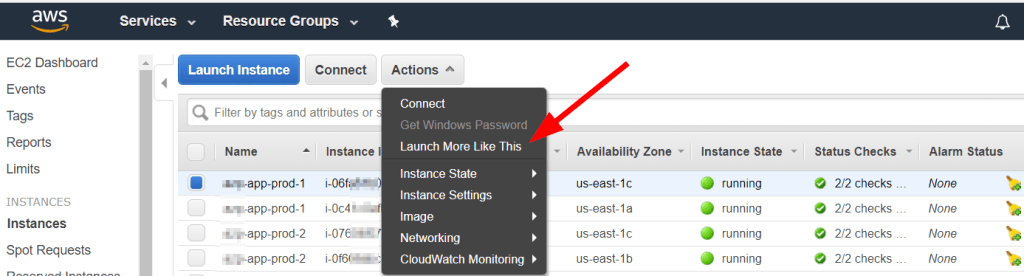
Amazon Elastic Compute Cloud (EC2) is a web-based cloud computing service provided by Amazon Web Services (AWS) that enables users to rent virtual computers on which they can run their own applications. EC2 allows users to quickly and easily provision a virtual machine (i.e., an instance) with the desired configuration, including a choice of operating system, CPU, memory, storage, and network options.
Users can choose from a wide selection of instance types optimized for different workloads, including general-purpose, compute-optimized, memory-optimized, and storage-optimized instances. EC2 also provides other features such as Auto Scaling, which allows users to automatically adjust the number of instances based on demand, and Elastic Load Balancing, which distributes incoming traffic across multiple EC2 instances.
EC2 instances can be used for a variety of purposes, including hosting websites and web applications, running database servers, processing big data and analytics workloads, and running machine learning and AI algorithms. Users can pay for EC2 instances on a pay-as-you-go basis or opt for reserved instances to save money on long-term usage. EC2 also integrates with other AWS services, such as Amazon S3 for storage and Amazon RDS for managed databases, to provide a complete cloud computing solution.
Amazon RDS (Relational Database Service) is a managed database service provided by Amazon Web Services (AWS) that makes it easy to set up, operate, and scale a relational database in the cloud. With Amazon RDS, users can choose from several popular database engines, such as Amazon Aurora, MySQL, PostgreSQL, Oracle, and SQL Server, and run them in a fully managed environment, with automatic software patching, backup and recovery, and scaling.
Amazon RDS takes care of routine database tasks such as hardware provisioning, database setup, patching, backup, and recovery, leaving users free to focus on their core business applications. RDS also provides several scaling options, such as horizontal scaling using Read Replicas and vertical scaling using Elastic Inference, to meet the changing demands of applications.
With RDS, users can choose between several deployment options, such as single-AZ, multi-AZ, and global databases, to achieve the desired level of availability and performance for their applications. RDS also integrates with other AWS services, such as Amazon EC2, AWS Lambda, and Amazon CloudWatch, to provide a complete cloud computing solution.
By using Amazon RDS, users can achieve cost savings, higher availability, and better scalability than traditional on-premise database solutions while benefiting from the flexibility and agility of the cloud.
Note: Amazon EC2, AWS Lambda, and Amazon CloudWatch are three different services provided by Amazon Web Services (AWS) that serve different purposes:
1. Amazon EC2 is a web-based cloud computing service that allows users to rent virtual machines to run their applications. EC2 allows users to choose the configuration of their virtual machines, such as the operating system, CPU, memory, storage, and network options. Users can run a wide variety of applications on EC2, including web servers, databases, and analytics tools.
2. AWS Lambda is a serverless computing service that allows users to run code without provisioning or managing servers. With Lambda, users simply upload their code to AWS and Lambda takes care of running and scaling it in response to incoming requests. This enables users to build highly scalable, event-driven applications without worrying about managing infrastructure.
3. Amazon CloudWatch is a monitoring and management service for AWS resources. CloudWatch collects and tracks metrics, logs, and events from various AWS services, including EC2 and Lambda, and provides a unified view of the operational health of the services. CloudWatch also provides alerts and notifications based on predefined thresholds, enabling users to take corrective action proactively.
In summary, Amazon EC2 provides virtual machines for running applications, AWS Lambda provides a serverless computing environment for running code, and Amazon CloudWatch provides monitoring and management for AWS resources. While they can be used together, they serve different purposes and are designed to meet different needs.
Reach out with questions, and feel free to leave comments!


 That's News To Me